
St. Bernard Projected Release Dates
A projected release date is a forward-looking calculation. Louisiana DPS&C uses the exact term “projected release date” for the date available through its telephone locator when applicable. The calculation can reflect sentencing documents, time credited in jail, concurrent or consecutive terms, offense classification, earned credit, lost credit, program credit, later court action, and other holds. It is not a release order or a promise.
An actual release date records a custody movement that already occurred. It must be read with the movement type and destination. Someone can leave St. Bernard Parish Prison for another parish jail, a DPS&C reception center, USMS, or ICE. That is an out date from one building, but it is not community release. A community departure may still begin parole, probation, or good-time supervision. Full discharge comes later if supervisory duties remain.
| Date or event | What it means | Best source |
|---|---|---|
| Projected release date | Current state estimate after record processing | DPS&C telephone locator |
| Parole eligibility date | First date a qualifying case may be considered | Statute, Master Prison Record, and Committee materials |
| Parole grant | Committee approval subject to conditions and processing | Committee decision |
| Actual out date | Recorded departure from a facility | Jail or prison movement record |
| Sentence discharge | End of the controlling custody and supervision term | DPS&C or court completion record |
Find St. Bernard Inmate Release Dates
Start with custody type. A person held before trial at St. Bernard Parish Prison usually lacks a fixed sentence-based release date. Bond, dismissal, a court order, a detainer, or case resolution can change the timing. A locally sentenced person may have a jail calculation tied to the court minute. A Louisiana felony sentence can remain under state legal custody even when the person is housed in the parish prison.
Use this sequence for a St. Bernard Parish release-date lookup:
- Check the booking, court case, or current status to decide whether the matter is pretrial, parish-sentenced, state-sentenced, federal, or an immigration handoff.
- For a state case, search Louisiana LAVNS by name or ID/case number. Read the exact custody or community status and update time.
- Call the DPS&C locator at 225-383-4580 with the DPS&C number or the person's name and date of birth. Ask for the “projected release date, if applicable.”
- For a local sentence or pretrial case, call St. Bernard Corrections at 504-278-7645 and obtain the controlling court minute from the St. Bernard Clerk.
- After the projected date, confirm the release sheet or movement record and its destination. Do not infer release from a roster non-result.
St. Bernard State Release Source
The official DPS&C inmate information page documents the locator inputs, the projected-date label, and the state system's limits. Its screenshot appears below.
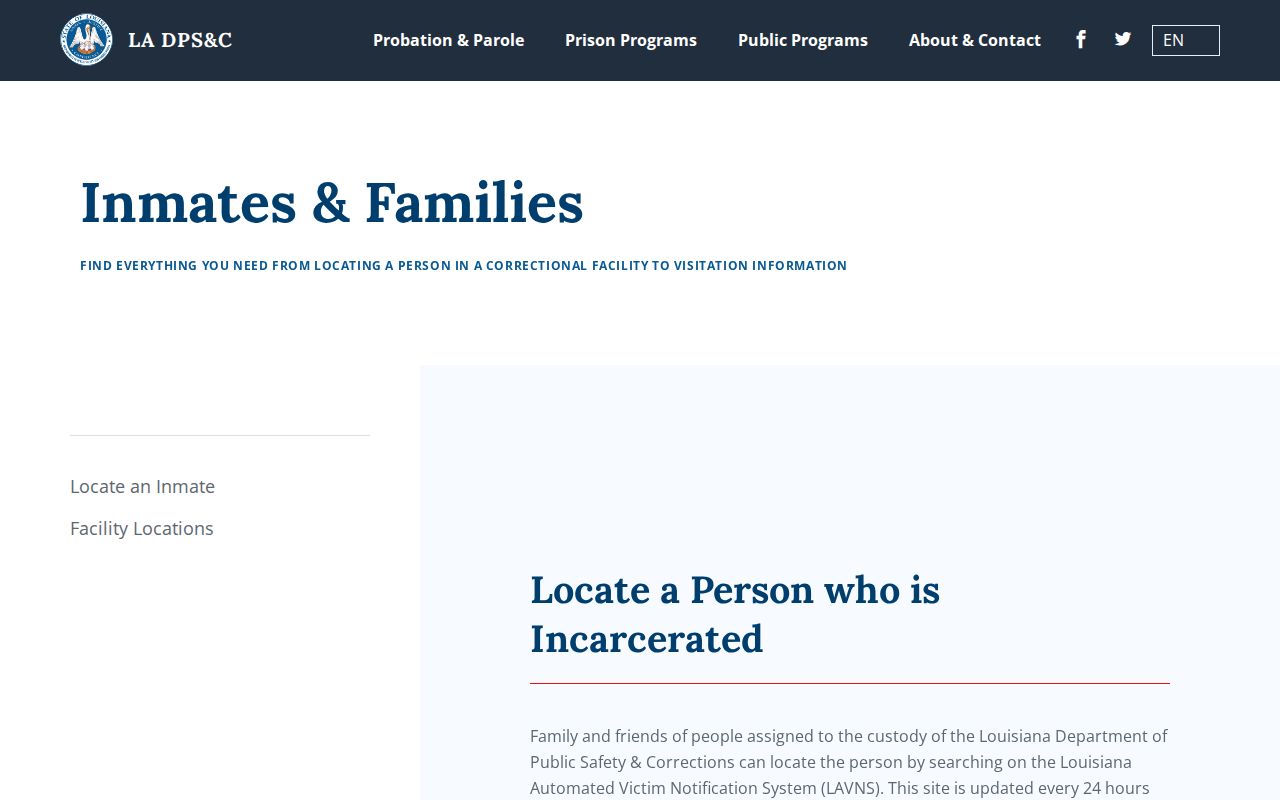
That state route applies to DPS&C custody and community supervision. It is not a permanent archive for every fully discharged person and does not replace the local jail movement record.
The St. Bernard Parish released-inmate records page provides the full local path when the task is to prove where the person went after leaving the parish facility.
St. Bernard Good-Time Date Split
Louisiana's good-time rules cannot be reduced to one percentage. The first question is the offense date. Cases involving an offense before August 1, 2024 fall under the older framework in R.S. 15:571.3. That law contains several rates and exclusions based on the sentence, custody type, violent or nonviolent classification, prior record, and other facts. One older parish-prison category for a qualifying first violent conviction produces the familiar rough 85-percent shorthand, but it is not a statewide rule for all inmates.
Under the older provisions, an eligible parish prisoner serving without hard labor may earn 30 days for 30 actual days. A qualifying first violent conviction in the relevant parish category earns three days for 17 actual days, while a second violent conviction is excluded from that formula. DPS&C felony classifications can apply different ratios, including 13 days of diminution for seven actual days in an eligible nonviolent category and one day for three actual days in a qualifying first violent category on the dates and classifications set by the law. Habitual, sex, repeat, and other categories require separate analysis.
The older good-time law screenshot captured below is the successful manifest source for that statute.
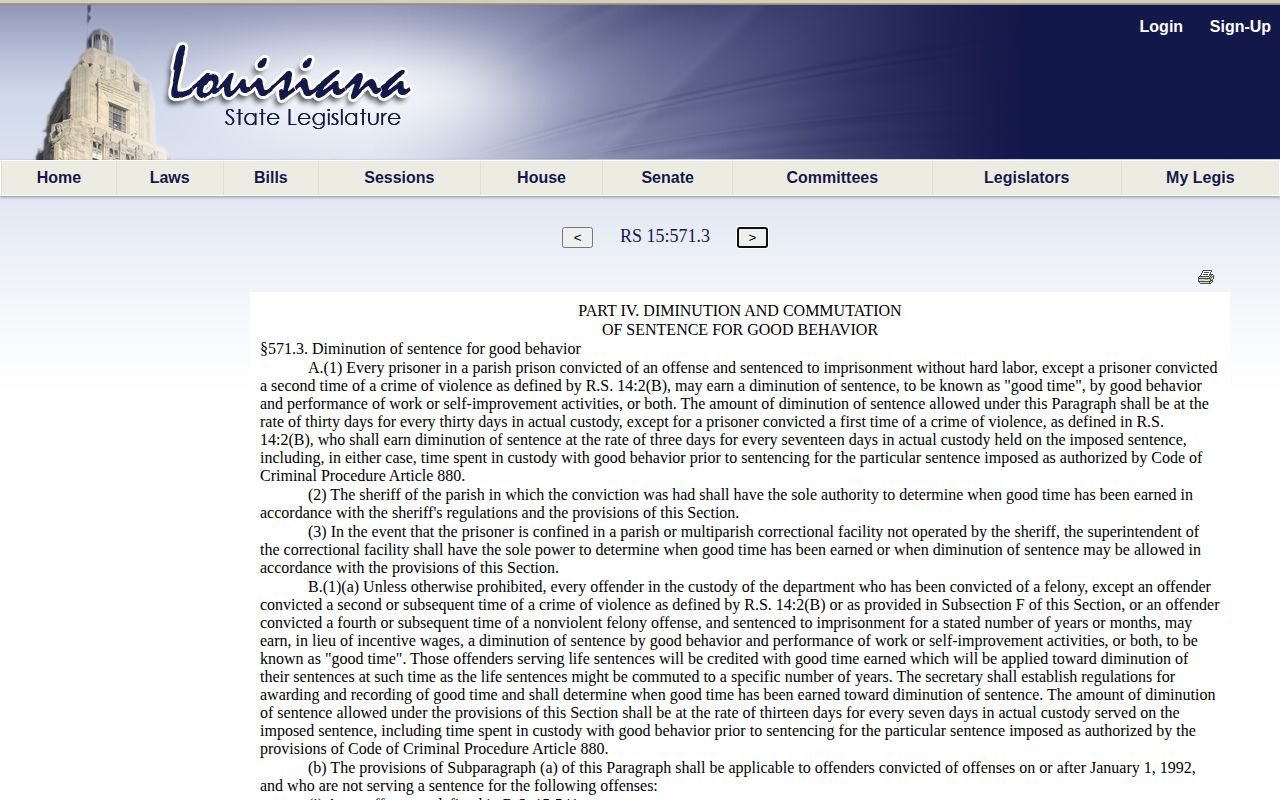
The statute text shows why an estimate based only on a charge name or a broad percentage can be wrong.
New St. Bernard Release Credits
For an offense committed on or after August 1, 2024, R.S. 15:571.3.1 generally allows an eligible felony offender in parish prison or DPS&C custody to earn up to 15 percent of the imposed sentence. The ordinary provision excludes sex offenders and habitual offenders. Presentence time credited under Code of Criminal Procedure art. 880 does not itself earn this good time.
Other parts of the calculation remain important. Eligible program credit may arise under R.S. 15:828. Credit may be forfeited under R.S. 15:571.4. The remainder of a term can carry statutory supervision rather than unconditional discharge. A court amendment, consecutive sentence, revocation, or detainer can also move the date even if earned credit remains intact.
The current post-August 2024 statute screenshot gives the official offense-date scope.
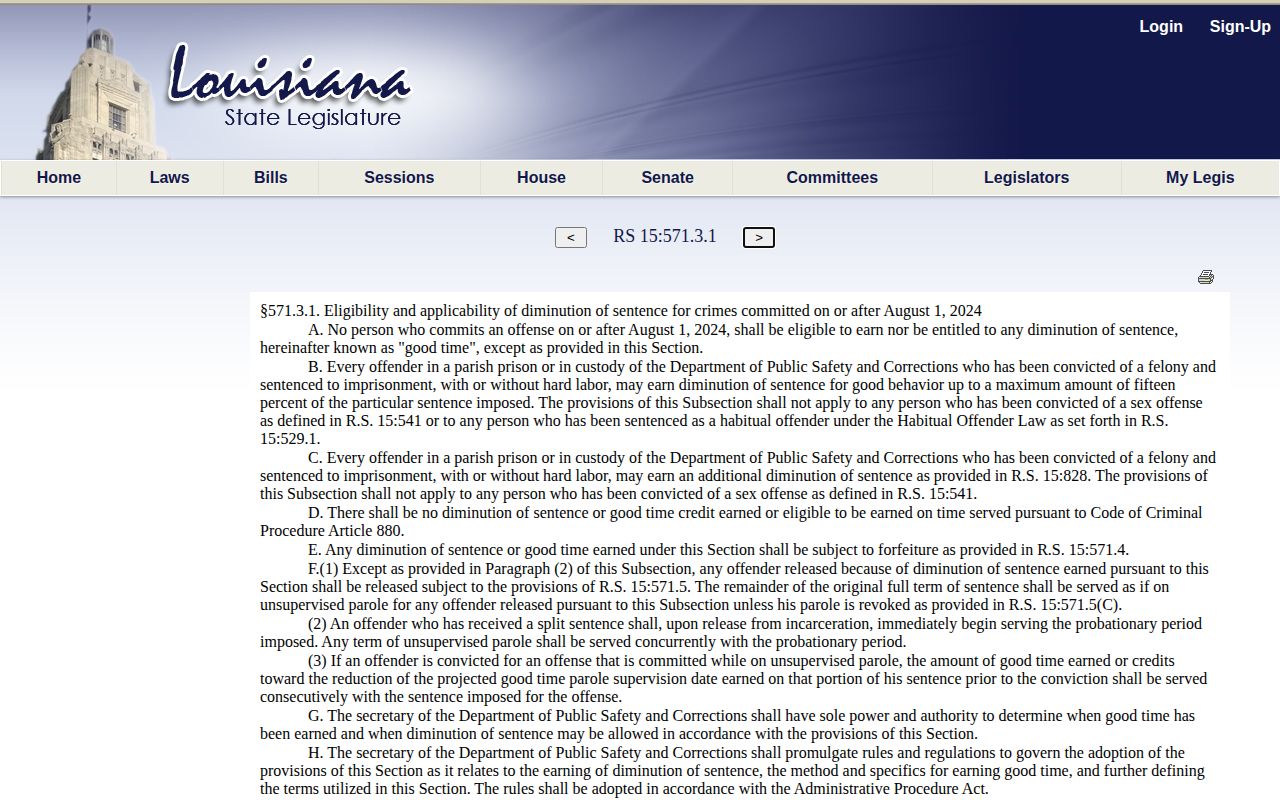
Use this source to identify the governing framework, then obtain the agency's actual calculation for the named case. The later law's 15-percent ceiling is not proof that a named person earned the full amount or qualified at all.
St. Bernard Master Prison Record
The channel-specific record behind a state date is the Master Prison Record, which DPS&C describes as the sentence-calculation record. It brings together the official sentencing papers and the custody facts used by the department. If the automated system has no date, DPS&C warns that documents may not yet have arrived or been processed. Guessing from the imposed sentence fills that gap with an unsupported number.
A practical review checks the offense date, every sentence, whether terms run at the same time or one after another, the sentence start, art. 880 jail credit, violent or other classification, old or new law, earned and forfeited days, program credit, amendments, revocation, and the supervision term. “Concurrent” means sentences run together. “Consecutive” means one follows another. A “detainer” is a request or hold from another authority that can prevent community release.
St. Bernard's mixed-custody setting adds another source check. A person can serve a DPS&C sentence while housed in a parish facility, so the building name alone does not tell who computes the date. The sentencing minute identifies the sentence. The jail record shows local custody and movement. The DPS&C number connects the state calculation across transfers. When those sources use different dates, record what each date represents instead of choosing the earliest one.
Questions about a state calculation go to 225-342-0799 or the facility Records Office, not the general public-record email. A person in a local facility follows the administrative remedy route identified by DPS&C when contesting the computation. A narrow public-record request can ask for a releasable discharge fact, but R.S. 15:574.12 restricts broad prison, preparole, disciplinary, and other official-duty material.
Why St. Bernard Release Dates Change
A projection is a snapshot of the record at the time of the calculation. Later facts can advance, delay, replace, or make the date inapplicable. The cause should be verified through the agency or court that controls it, not assumed from a changed screen.
| Factor | Possible effect | Record to check |
|---|---|---|
| Official papers received or corrected | Creates or revises the state calculation | Master Prison Record and sentencing documents |
| Earned or program credit | May move an eligible projection earlier | DPS&C credit calculation |
| Credit forfeiture | Can move the projection later | Authorized DPS&C record |
| Other sentence or court order | Changes the controlling term or sequence | Court minute and amended commitment |
| Detainer or receiving agency | Prevents community release after one facility's out date | Movement destination and receiving intake |
| Parole action or revocation | Changes the route to or from supervision | Committee decision and current custody status |
A projected date passing without departure does not establish an error or unlawful detention. Another term, forfeiture, hold, correction, or unprocessed order may explain the change. Ask the responsible records office for the current calculation and its governing source.
Parole adds a separate decision point. Eligibility only allows the Committee to consider the case. A grant can still be followed by conditions, plan review, and administrative processing before the actual gate date. For offenses on or after August 1, 2024, R.S. 15:574.22 generally bars parole under the relevant Part except for its listed categories. Older cases use the category rules in R.S. 15:574.4. Neither statute should be used as a do-it-yourself release calculator.
Confirm St. Bernard Actual Release
Confirmation requires a past event, not a forecast. For St. Bernard Parish Prison, ask for the release sheet, custody history, movement log, or equivalent record. Request the actual date and time, movement type, and destination or receiving agency. Pair that record with the court order that explains the legal basis. For a state departure, check the updated LAVNS status and DPS&C record.
A closed factual question can prevent a transfer from being mistaken for freedom: ask whether the last St. Bernard movement was release to the community, transfer to another custodial authority, or another recorded status. If telephone staff provide only current-custody information, follow with a narrow written request. A receiving-agency intake can then complete the movement chain for DPS&C, another parish, USMS, BOP, or ICE. The state and federal systems answer only for their own custody. Record the date and department for each call so later updates can be compared with care.
Notification can help with timing. Register on the matched Louisiana LAVNS record for the available custody-change or release event and keep the telephone PIN private. The St. Bernard VINELink release check explains that specific-person registration path. An alert is still not a certified release record and may arrive after the agency update.
Use precise terms in the final timeline: projected date, parole eligibility, Committee grant, court order time, jail out time, receiving-agency intake, community-supervision start, and discharge. When two dates differ, label both instead of forcing them into one “release date.” A transfer date proves departure from one facility, but the receiving agency determines whether custody continued elsewhere.