
Federal BOP Release Paths
The BOP system applies after a federal sentence and designation. A federal defendant may first be arrested or housed locally under USMS authority. Leaving St. Bernard Parish Prison for USMS is a transfer, not community release. Once designated, the person may move through BOP institutions, a residential reentry setting, home confinement under lawful authority, release with federal supervision, or sentence completion.
The federal docket explains detention orders, sentence, amendments, and supervised-release terms. The BOP locator supplies custody or released-result data within its scope. The sending jail record establishes the parish out event. Keep these records separate.
| Recorded path | What it means | Next check |
|---|---|---|
| USMS transfer | Federal pretrial or movement custody continues | Federal docket and USMS |
| BOP designation | Sentenced federal custody | BOP Locator |
| Released result | BOP records a release date | Locator details and docket |
| Supervised release | Community supervision may follow prison | Federal judgment and probation office |
Confirm Federal BOP Release
The BOP Inmate Locator accepts a BOP, DCDC, FBI, or INS number, or a name with identifying details. Number search is strongest when the identifier is sound. A name search needs identity checks because initials, suffixes, and same-name records can mislead.
- Confirm that the case is federal through the federal docket or recorded USMS/BOP destination.
- Search by federal register number when known, then compare name and identifying details.
- Read the exact status, location, or released date shown in the full result.
- Compare that result with the judgment and later docket activity.
- For a recent pretrial handoff with no BOP result, use the docket and appropriate USMS contact.
The broader St. Bernard Parish released-inmate search explains how jail, court, state, and federal records fit together. Use that route when the correct custody class is not yet known.
Federal BOP Records Route
BOP Locator is the first public route for sentenced federal custody and many former prisoners. Its historical coverage has limits, so an absent record cannot settle every older or non-BOP case. The federal clerk docket is the durable legal source for detention, judgment, and supervised-release terms. USMS controls many pretrial movements.
Federal Bureau of PrisonsNationwide federal custody system
Public route: BOP Inmate Locator
Search by number or identity details
Federal cases require the federal docket
When the St. Bernard record says USMS, request the local movement record for its date and destination, then follow the federal case. Do not expect Louisiana LAVNS to track federal custody. Likewise, a BOP result does not prove the date a person left the parish building.
A released BOP result may preserve a federal release date. It does not establish that every unrelated Louisiana hold ended, nor does it erase a supervised-release term imposed in the judgment.
St. Bernard Federal Evidence
No current federal prison was identified in St. Bernard Parish. An archived DOJ table once listed 50 federal prisoners at “BERNARD PARISH PRIS.” That is dated historical evidence, not proof of a current contract or current federal population.
The manifest includes a successful capture of the BOP locator interface. The official source is shown because it is the matching federal search channel.
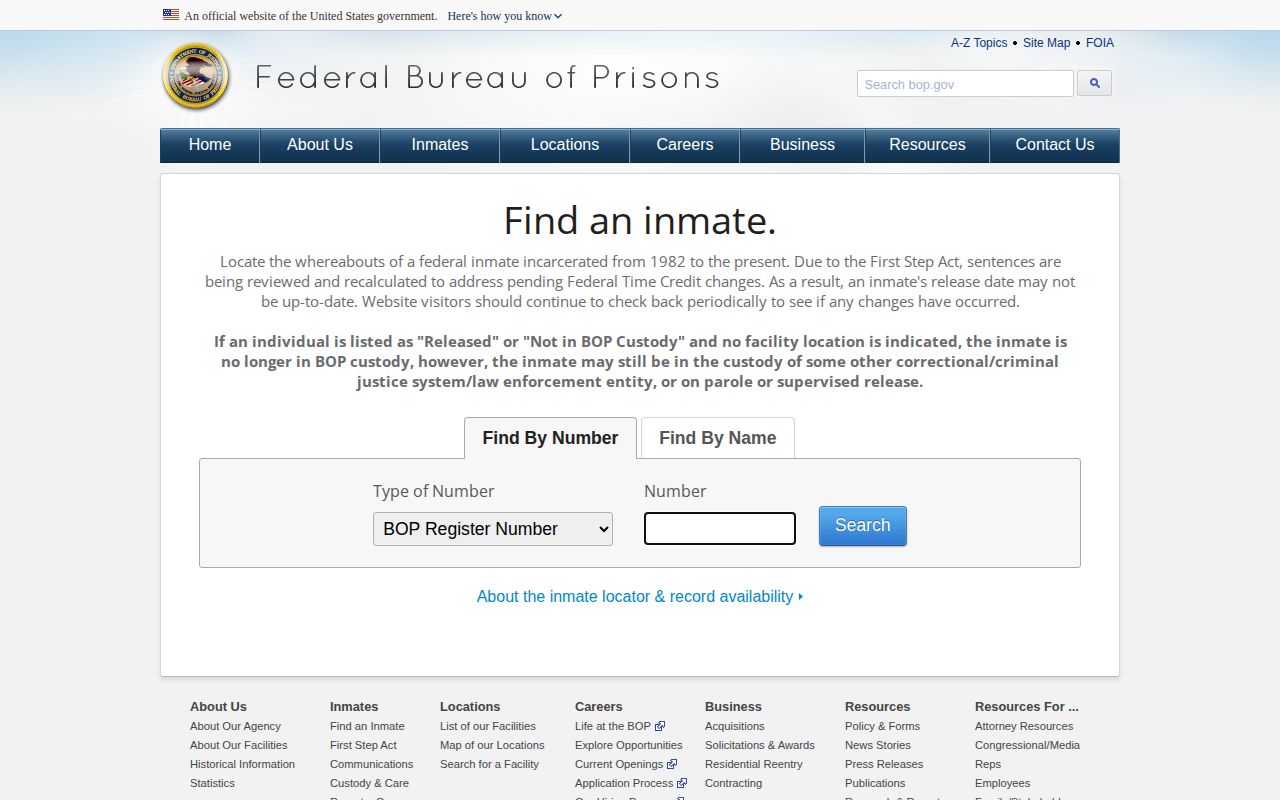
The interface supports a federal search. It is not a St. Bernard Parish release list and shows no result until a valid query is run.
Federal Pretrial Custody Limits
USMS commonly manages federal pretrial detention. Contract housing can place a defendant in a local or regional facility without making that site a BOP prison. A pretrial person may therefore fail to appear in the BOP locator even though federal custody continues.
Use the detention order, federal docket, and sending movement record. After sentencing and designation, BOP data may appear. This sequence explains why immediate BOP searching after a parish handoff can produce no result.
Note: Federal custody authority, physical housing, and BOP designation are separate facts and can change at different times.
Federal Receiving-System Distinction
BOP, USMS, ICE, Louisiana DPS&C, and SBSO are distinct systems. A federal criminal transfer belongs to USMS and the federal docket. A sentenced designation belongs to BOP. An immigration detainer belongs to ICE. A Louisiana felony belongs to DPS&C.
Search failure in one system should trigger classification, not a release claim. Start from the recorded destination or case jurisdiction, then move to the system that received the person.
Federal supervised release is ordered by the court and usually follows incarceration. It is not BOP confinement. The judgment and federal probation records, within their public limits, provide that later context.
Read Federal Release Results
A BOP “Released” label and date are strong federal custody facts within the locator's scope. They do not explain every court condition or other sovereign's hold. “Not in BOP custody” is less specific and must be reconciled with the docket.
- USMS custody
- Federal detention and movement authority often used before BOP designation.
- BOP designation
- Assignment of a sentenced person within the federal prison system.
- Released
- A BOP locator status that may carry a federal release date.
- Supervised release
- A court-ordered community term distinct from BOP imprisonment.
Record the parish out time, federal intake or designation, BOP release date, and supervision start as separate events. That timeline avoids turning a federal handoff into a false community-release claim.
BOP's locator records cover many federal prisoners from 1982 forward, but scope and data limits still matter. An older case, a person held only by USMS, or a person outside BOP responsibility may require the federal clerk record. Search results should be saved with the access date and exact status words.
A federal judgment can impose imprisonment followed by supervised release. The prison term and community term are separate. When BOP shows “Released,” review the judgment for later supervision and the docket for amendments, revocation, or another detention order. Do not describe the whole federal sentence as discharged based solely on release from BOP custody.
A same-name match needs more than a familiar name. Compare register number, age or birth data, race and sex fields where lawfully displayed, and case geography. Do not publish sensitive identifiers beyond what is needed to explain the verified record. If identity remains uncertain, stop at “possible match.”
For a St. Bernard Parish handoff, the local record should state the actual movement date and receiving authority. The federal docket may show a detention order before that physical transfer. BOP designation may come after sentencing. These three dates can differ without contradiction because each records a different step.
Federal release may also be followed by custody under a different sovereign. An ICE hold, Louisiana warrant, or another jurisdiction can change the destination. The BOP locator speaks to BOP custody only. Check any recorded receiving agency rather than assuming the person entered the community.
If the locator gives a release date, cite it as the BOP-recorded federal release date. If it only says the person is not in BOP custody, use narrower language. The latter phrase does not identify when custody ended, where the person went, or whether supervision continues.
The federal docket should be searched by the correct district and case number when possible. Detention hearings, commitment orders, judgments, sentence reductions, and revocation entries can change the custody story. A docket entry is legal-process evidence, not an automatic physical-location update. Compare it with BOP and USMS facts.
When BOP assigns an institution, use the facility shown in the current result rather than assuming the nearest federal prison. No federal prison is identified in St. Bernard Parish. Transfers within BOP custody do not create a new community release date. They are internal federal movements until a released status or other official record shows departure.
A locator screenshot or saved result should retain the access date and the displayed limitation. Dynamic data can change after transfer or release. If a later result differs, preserve both and explain the sequence rather than overwriting the earlier federal custody event.
For a records request, identify the federal register number, full name, date range, and exact existing record sought. Do not ask BOP or USMS to create a narrative explaining the whole case. The federal clerk can supply filed orders and judgments under its own access rules. The St. Bernard custodian can supply its movement record. Combining those agency-created records is more reliable than asking one office to certify events controlled by another. Any exemption or redaction should be reported by its cited basis, without guessing what the withheld material says.